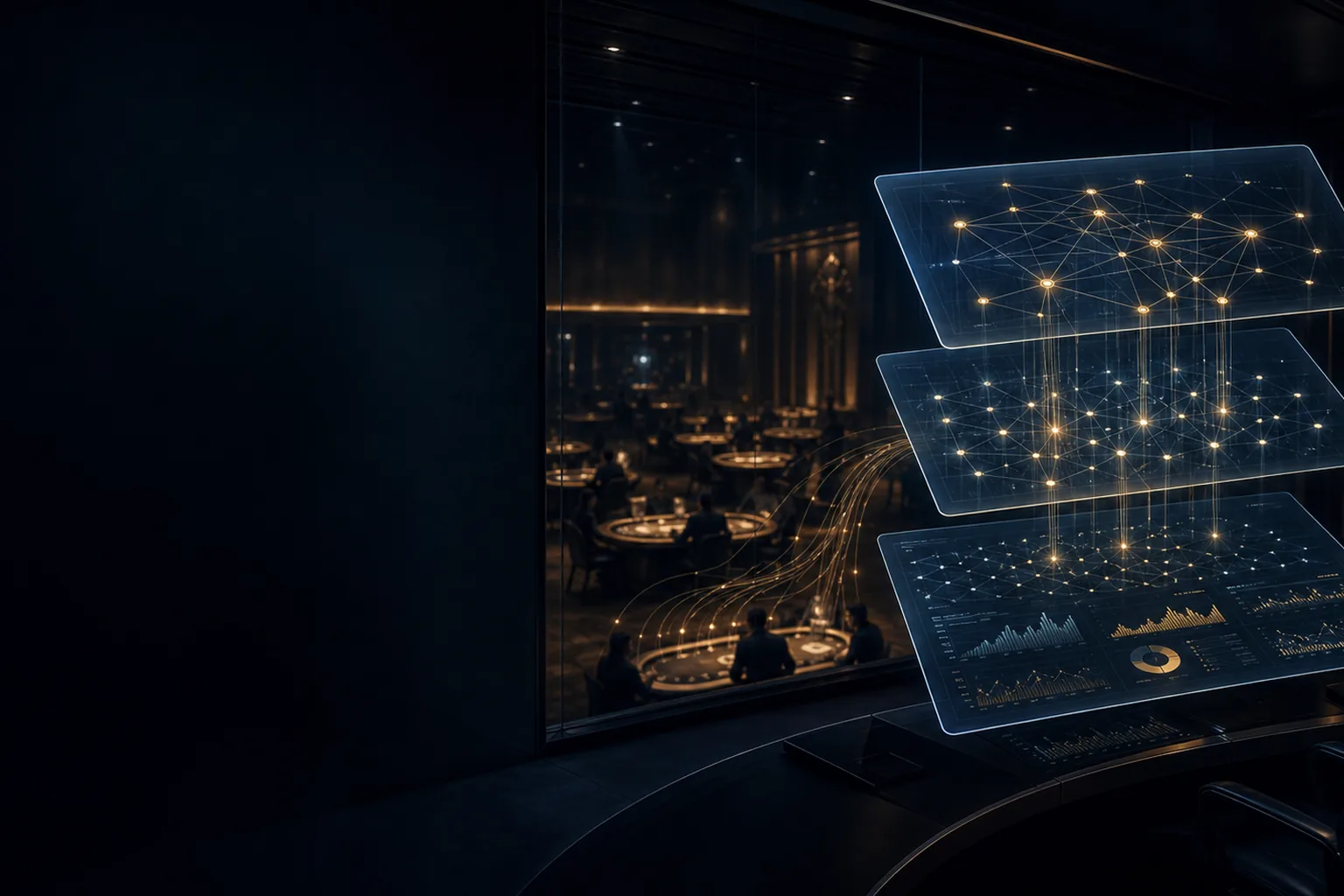
AI table activity infrastructure keeps poker club lobbies active during off-peak hours by deploying configurable AI agents that fill seats and maintain action density according to owner-defined parameters. Unlike DIY scripts running on someone's laptop, managed infrastructure operates on maintained servers, survives platform updates, and provides real-time telemetry through an owner-controlled dashboard. The system runs in two layers — a configuration layer (formats, stakes, time windows, concurrency caps, all owner-controlled) and a runtime layer (per-opponent profiling, session-level variation, behavioral plausibility). The goal isn't to win against live players; it's to keep lobbies visible and active during the hours when human traffic is sparse, so regulars arriving at 4am find a club with games rather than a ghost lobby.
What AI table activity actually is
The term "AI bots for poker clubs" often gets interpreted broadly — from primitive scripts to complex systems. Let's define what PokerNet does specifically.
AI table activity is a managed infrastructure that keeps table sessions live according to scenarios defined by the club. This isn't "bots that play against live players" — this is a tool for lobby and activity management, aligned with the club's objectives.
Where the term comes from and how it differs from "poker bots"
The phrase "poker bots" carries decades of baggage. For most operators it means individual scripts running on someone's laptop, configured to play hands and extract winnings from human players — the kind of thing major rooms ban and PPPoker, PokerBros, and ClubGG actively detect through pattern analysis. That's not what AI table activity is, and the terminology distinction matters because it changes the entire risk profile.
AI poker bots in the table activity context are agents whose only job is to maintain lobby fill and action density during periods when human players are sparse. They don't aim to win. They don't extract value from live players. They run on managed infrastructure rather than on a laptop in a back room. The behavioral profiles are designed for plausibility under casual observation, not for game-theoretic exploitation. We covered the failure modes of the older "DIY scripts" approach in our guide on bot activity in PPPoker anonymous clubs; the structural difference is that managed AI infrastructure is operated as a service with central oversight, while DIY bots are operated as standalone tools with all the brittleness that implies. Understanding this distinction is foundational — most concerns club owners raise about "AI bots" are concerns about the DIY model, not about managed infrastructure.
Infrastructure architecture
The PokerNet platform consists of three layers:
1. Orchestration layer
A central scheduler that determines which tables to keep active, at what limits, and in which time windows. All decisions are made based on club rules, not randomly.
2. Execution layer
AI agents that maintain the set activity level. Each agent operates within strict boundaries: limits, timing, session duration, behavior profiles.
3. Analytics layer
A unified monitoring panel: active sessions, occupancy by format, rake dynamics, agent-level events. The club sees everything happening in real time.
How the three layers communicate in real time
The architecture is intentionally not a single monolith. Orchestration, execution, and analytics are separate processes that exchange events through a message-passing layer rather than shared state. When a manager pauses a table through the dashboard, the analytics layer pushes the change to orchestration, which adjusts the active scenario set, which signals the execution layer's agents to wind down their session — all within seconds. The same path operates in reverse for telemetry: every agent action emits an event that flows back through analytics into the dashboard. This separation matters operationally because it means a problem in any single layer doesn't cascade. If the analytics dashboard goes briefly unavailable, orchestration and execution continue running on their last known configuration; if a single agent fails, orchestration redirects its workload without the manager ever seeing an interruption. This is what "managed infrastructure" actually means in practice — resilience built into the architecture rather than reliability promised in marketing copy.
Boundaries of application
It's important to honestly specify what AI infrastructure is not:
- It's not a tool for "playing against live players in the club's favor." Agents operate within open scenarios agreed with the club.
- It's not a replacement for a real active audience. AI supports the base, but club growth happens through marketing and community building.
- It's not a "black box." The club sees all activity parameters and can adjust scenarios at any time.
How AI poker bots adapt to club-specific scenarios
One of the most common questions from club owners evaluating AI infrastructure is whether the system is generic or actually configurable per club. The honest answer is that the orchestration layer is generic — the same scheduler runs across every deployment — but the scenario definitions are club-specific to a degree that surprises operators evaluating the platform for the first time.
Configuration covers four dimensions. Format mix: NLH-only, NLH+PLO, full three-format support including Short Deck, with independent calibration per format. Limit ladder: which stakes get prioritized for active table maintenance, which run on lower-priority scenarios, which are off-limits to the system entirely. Operational windows: when AI runs at full capacity (typically 2am–7am local), when it ramps down (shoulder hours), when it's effectively dormant (peak organic traffic). Behavioral profiles: conservative seat-fill versus higher-engagement scenarios, with the choice driven by what the club is trying to achieve at that hour.
None of this is set once and forgotten. The strongest deployments iterate weekly during the first 30 days, refining the calibration based on live data — which limits over- or under-perform, which time windows need adjustment, which formats benefit from more aggressive seat-filling. The economic case for this iteration is documented in our poker bot ROI piece: the difference between "set and forget" deployments and actively-managed ones is roughly 40% of the available rake recovery, which compounds over time into the difference between a club that grows and one that plateaus.
What the club actually gets
In practice, over the first 30 days after connection clubs fix:
- +15–25% off-peak rake (night hours, early mornings).
- −3–5 hours of manual work per night-shift manager.
- +15–30% player retention over 90 days.
- A stable analytics panel with honest metrics — for informed scaling decisions.
AI infrastructure isn't magic. It's a management tool that lets a club grow predictably when it has a clear understanding of its own economics.
Format-specific deployment: NLH, PLO, Short Deck differences
The architecture is the same across formats, but deployment is not. Each format has structural differences that change how AI poker bots are calibrated and what success looks like operationally.
NLH deployment is volume-oriented. The agent population is larger because NLH lobbies recover fastest with continuous seat-filling, and the behavioral profiles emphasize plausibility under casual observation rather than play strength. Most NLH deployments run at 2/4, 5/10, and selectively at higher stakes during off-peak. Action density targets sit at 50–70 hands per hour, which matches what regulars expect from a healthy lobby.
PLO deployment is density-oriented. The agent population is smaller — PLO regulars are more experienced and notice patterns faster — but the calibration is more sophisticated. Behavioral profiles are configured per position (early, middle, late) rather than uniformly, because PLO's wider opening ranges make positional play observable in ways that NLH's tighter ranges don't. Profile libraries get updated quarterly as the PLO meta evolves at popular limits.
Short Deck deployment is timezone-oriented. The orchestration layer for Short Deck runs on Asian-market schedules: peak organic traffic from late afternoon through midnight Asian time, off-peak coverage from late night through early morning Asian time, dormant during Western daytime. Format calibration accounts for the shorter deck (36 cards), the ante structure, and the higher action density that defines the format. Pools are smaller, which means agent counts are smaller, but each agent operates more visibly because the player community is tighter.
Why this doesn't break club economics
A reasonable question: if AI keeps table activity going, does this affect rake quality or the ratio of live to managed activity?
The answer is in how scenarios are configured. PokerNet does not replace live audience — it complements it in periods when live activity is lowest. In peak hours, the system gives way to live players; during off-peak hours, it keeps tables from collapsing. This is the difference between healthy infrastructure and random scripts.
What changes operationally for the club's manager
The operational impact is rarely what owners expect when they first evaluate the platform. The expectation is usually "the AI replaces a few hours of manual work per night." The reality is more structural: the manager's job changes shape because the manual seat-filling work disappears entirely, and what remains is closer to what the role was meant to be — relationship management, dispute resolution, strategic decisions about format mix and limit ladder, agent coordination, growth campaigns.
Concretely, on a typical deployment, a manager who previously spent 4–5 hours per shift coordinating off-peak activity (pinging regulars on Telegram, manually filling seats with prop accounts, fixing scripts that broke after the latest app update) recovers most of that time. What replaces it is configuration work during the first 30 days of deployment — calibrating the system to the club's specific patterns — and ongoing review of the analytics layer to catch trends that need attention. After the calibration window, ongoing manager involvement drops to roughly 2–3 hours per week of operational review, with full control retained through the dashboard for any real-time intervention. The integration of off-peak rake recovery with manager time saved is documented in our off-peak rake growth piece; the operational change is what makes the economic change sustainable rather than fragile.